For the love of the hospice movement - Barbara's story

Barbara’s connection with hospice care began with her father.
He had been very ill with pancreatic cancer, first in Lewisham Hospital and then at St Christopher’s Hospice in Sydenham, founded by Dame Cicely Saunders in 1967 as a pioneer of modern hospice care. She, too, died there in 2005.
Like many people, Barbara did not know what to expect; she imagined a hospice would be sad and frightening. However, from the first day she visited her father, she discovered something very different.
The atmosphere was calm and kind. People spoke gently. The staff explained what was happening and treated her father with great care. When Barbara was told one evening that he was unlikely to live through the night, she ran down to the hospice chapel in tears. In that moment, a Roman Catholic priest opened his arms to her, offering the steady reassurance she so desperately needed.
That kindness stayed with Barbara. Her father died during the night, but the care he received and the compassion shown to her family changed the way she understood hospices forever. What had once been unfamiliar became deeply personal.
“Hospice is not the sad word that you think it is,” she said. “If anything, it’s a lovely way to end your life, because they’re such caring places.”
When Heart of Kent Hospice opened locally, she wanted to give her time to help ensure the hospice succeeded. At her interview, she was asked whether she would like to help with teas and coffees, but Barbara knew exactly where she wanted to be.
“No,” she said. “I want to be with the patients.”
Hospice volunteering was a natural fit for Barbara. Her years as a hospital medical secretary and a learning support assistant for children with special educational needs at a Roman Catholic school had given her a calm, compassionate presence. At the hospice, those qualities mattered. Sometimes, the most important thing she could offer was simply to sit, listen and reassure someone that they were not alone.
One of her first memories was sitting beside a woman who held her hand so tightly that Barbara thought she might lose her rings. The woman kept asking, “You’re still there, Barbara?” And Barbara answered, “Yes, I’m still here. I won’t leave you.”
Across nearly forty years, Barbara has remained connected to the hospice movement. She has attended events, supported raffles, sent donations and kept treasured papers, photographs and invitations safe in carefully organised folders. She remembers the opening of Heart of Kent Hospice and standing at the front when Diana, Princess of Wales, came to visit. Barbara had entered a ballot to attend, arrived early, and was close enough to shake her hand, a moment she never forgot.
Her memories are not just souvenirs. They are part of the hospice’s history. In her folders are traces of people, places and moments that might otherwise have been lost: invitations, photographs, letters and cuttings, all kept because they mattered to her. Barbara understands that these things tell a bigger story, of a community that cared enough to build something lasting.
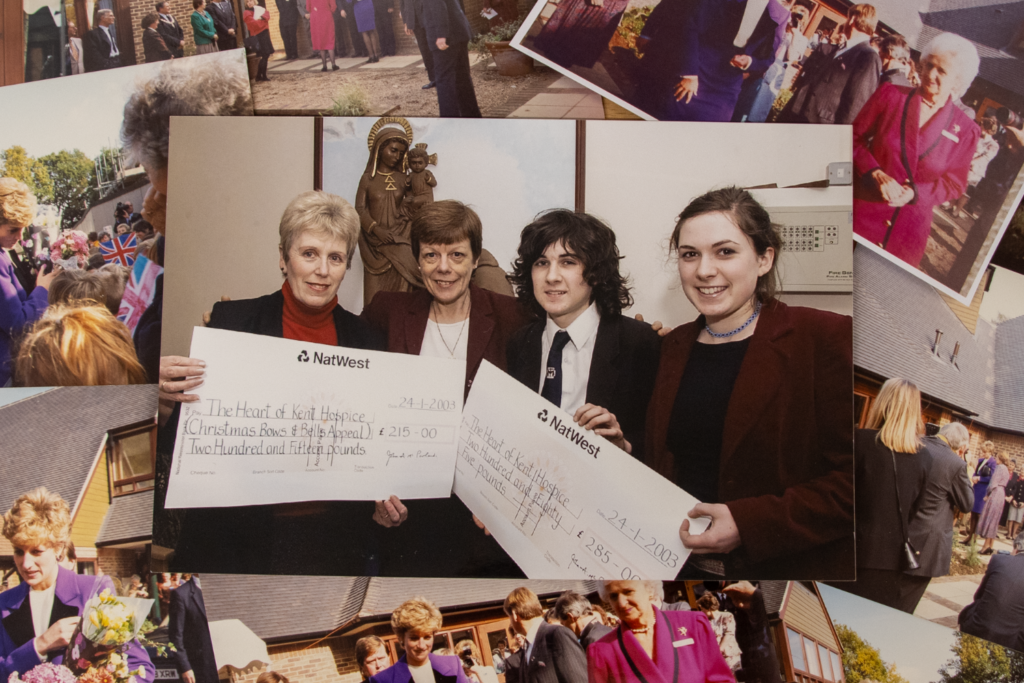
She has seen hospices change over the years. More people understand them now. More people volunteer, visit, support and speak about them. Yet, to Barbara, the heart of hospice care has stayed the same. “It is still about kindness. It is still about calm. It is still about being there when someone needs you most.”
Her hope for the future is simple: that Heart of Kent Hospice will continue to be supported, wherever it is based, and that people will keep discovering what she discovered all those years ago at St Christopher’s - that a hospice is not only a place for dying, but a place of dignity, comfort, friendship and love.
Barbara’s story began in grief, but it became a lifetime of connection. From her father’s bedside to the patients she sat beside, from raffles and sunflowers to royal visits and carefully saved memories, she has carried the spirit of hospice care with her. And, just as she once promised a frightened patient, her message has always been the same:
“I’m still here. I won’t leave you.”